
Built by hand
This is the story of building a small cabin in Surge Narrows — one decision, one lesson, one dusty day at a time.
Keep reading to see the behind-the-scenes work, the imperfect moments, and the quiet satisfaction of making something that feels rooted, durable, and real.
Why we chose to build
We didn’t set out to build a “vacation rental.”
Initially, Mike started building it during Covid to have a space for himself while working on projects in the Discovery Islands as he also was starting his solar business. He wanted to create a small place that felt calm, grounded, and useful — a place designed for slowing down rather than filling space.
After we got married, we started thinking more about the future of the cabin and how we'd like to share it with others. The idea of renting it out to people floated around, and we found ourselves falling in love with the idea. We could have not only friends stay, but others who would love to spend time fishing and prawning (what Mike probably loves the most), or just watching the amazing sunrises and sunsets while exploring the forest (my favourite part).


Rock drilling
The cabin sits mostly on bedrock.
To create a usable outdoor patio, we spent long days drilling hole after hole directly into the rock. Each opening was filled with a rock-breaking compound, then left to do its quiet work. After a few days, we returned to break the stone apart — lifting, levering, and tossing each piece over the edge into the ocean below.
Every time a layer came apart, it felt like we had moved so much rock. And every time, we stepped back and realized we weren’t finished yet.
We repeated the process again and again — drill, fill, wait, break — learning patience the hard way. What looked like progress was often just the beginning of the next layer.
We’re now on the final layer. Once it’s fully broken and shaped, we’ll pour cement to create a smooth, durable surface — a quiet reward after months of dust, noise, and persistence.

Doors with a story
The pocket doors began long before they ever slid into place.
Mike sourced locally salvaged cedar that had been uprooted during a massive landslide — trees torn loose and carried down into the ocean. A friend helped recover the wood, giving it a second life instead of letting it disappear back into the tide.
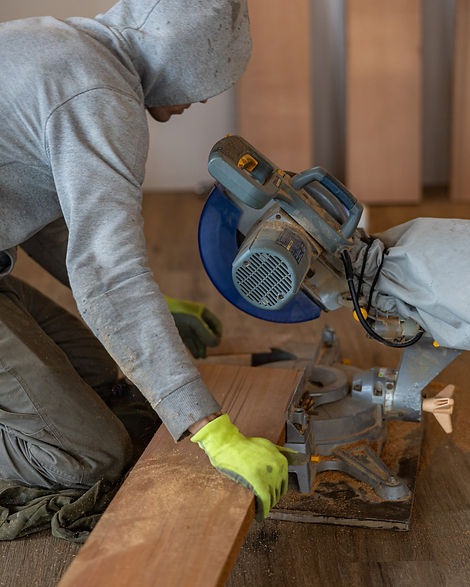
From there, the process became deeply hands-on. Mike cut the boards to size, then brought them to a neighbour’s shop to glue the doors together — a small, quiet collaboration rooted in place.
Back at the cabin, we spent a couple of long days sanding. Slowly smoothing edges, reading the grain, learning when to stop and when to keep going. Only after that did we stain the doors, watching the cedar deepen and come alive.
These doors carry more than function. They hold a story of place, patience, and craft — and yes, Mike is very proud of them. Rightfully so.


Kitchen cabinets
One piece at a time, the cabin kitchen is coming together. Lately Mike has been deep in the quiet rhythm of cabinet building — measuring, assembling, fitting everything together so it feels solid and right. It’s the kind of work that doesn’t shout for attention, but slowly transforms an empty space into something that will hold daily life. Every evening the kitchen looks a little more like a real kitchen and a little less like a construction project.
The part we’re most excited about is the cabinet faces. Mike is making them from beautiful, figured maple — local wood with those soft ripples and curls that catch the light when you turn it just right. Watching him cut the boards, sand them smooth, and bring out the grain with stain has been a reminder of how much character natural wood holds. Soon those pieces will be installed, and the whole kitchen will start to take shape. With the maple against the stainless counters and the forest just outside the windows, it’s going to look pretty epic.


Door trim
Progress at the cabin is rarely dramatic, but it's often found in the details.
Recently, Mike finished the cedar trim around the doors using boards he cut himself. After sanding and sealing them with a clear coat, they were finally installed, adding warmth and character to the space. It's remarkable how a seemingly small detail can make a cabin feel one step closer to finished. He's now turning his attention to the baseboards, which will be painted to blend with the walls and quietly tie the rooms together.
Working on an Of Surge & Keel board


The shop where we work at Mike's parents property next door

Late summer views from the shop next door at Mike's parents


Surge Narrows Collective is based on Read Island in the Discovery Islands, British Columbia, Canada.
ABOUT
SUPPORT
STAY IN TOUCH


© 2026 Surge Narrows Collective